Benchmarks and evidence
Ledge publishes measured, reproducible, protocol-compliant numbers and
nothing else. The protocol (benchmarks/README.md in the repository)
requires shared instance data, documented conversions, native statuses
verbatim, independent KKT re-verification of every returned point,
phase-split timing, and ≥10 repeats with all raw samples published.
The honest headline
- Dense-
Qusage of a general QP solver is 1–2 orders of magnitude slower than factor-aware solving. That gap is the cost of ignoring factor structure, measurable within the same external solver (dense vs lifted formulation). See the technical notedocs/factor_structure_note.md. - Ledge's comparative strength is rolling and turnover-aware workloads,
not universal cold-start speed. On instances with proportional (L1)
transaction costs — the realistic rebalancing case — Ledge is the
fastest solver at every size, cold and rolling, because the epigraph
reformulation external solvers need costs them 2–6x while Ledge's prox
block costs ~8%. On smooth instances a hand-lifted Clarabel formulation
remains the strongest cold baseline at
n >= 2000. - Ledge's audited residuals at defaults are
~1e-11or better since polishing; objectives across solvers agree once compared at comparable residuals.
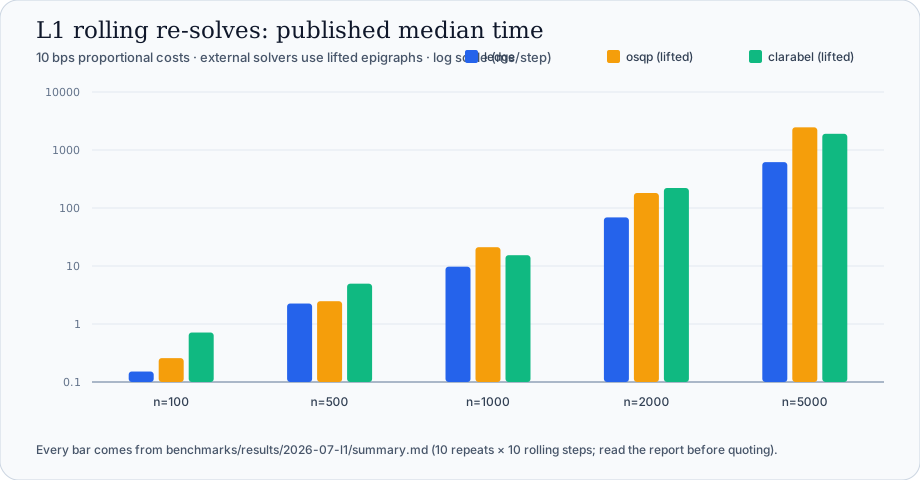
This chart is generated from the committed 2026-07-l1 report. It is a
visual index, not a substitute for setup/cold/residual details in the report.
Published reports
All under benchmarks/results/ in the repository, each with raw samples:
| Report | What it measures |
|---|---|
2026-07/ | first protocol report (pre over-relaxation) |
2026-07-over-relaxation/ | re-run after α=1.6 became the default |
2026-07-workspace/ | re-run after factorization reuse across solves |
2026-07-l1/ | re-run with polish defaults + L1 turnover instances (prox block vs epigraph) |
2026-07-batch/ | 1 model × 500 accounts × 250 dates batch throughput |
Reproduce
# Self-timing smoke matrix (no external solvers):
cargo run -p ledge-portfolio --release --example synthetic -- --n 500 --k 10 --seed 42

# Full protocol comparison (OSQP + Clarabel behind non-default features):
cargo run --release -p ledge-bench-adapters --features osqp,clarabel \
  --bin compare -- --out /tmp/comparison --repeats 10 --rolling-steps 10

# Batch throughput:
cargo run -p ledge-portfolio --release --features rayon --example batch
Read each report's findings before quoting any single number; the reports state where external solvers win.