Rolling rebalances
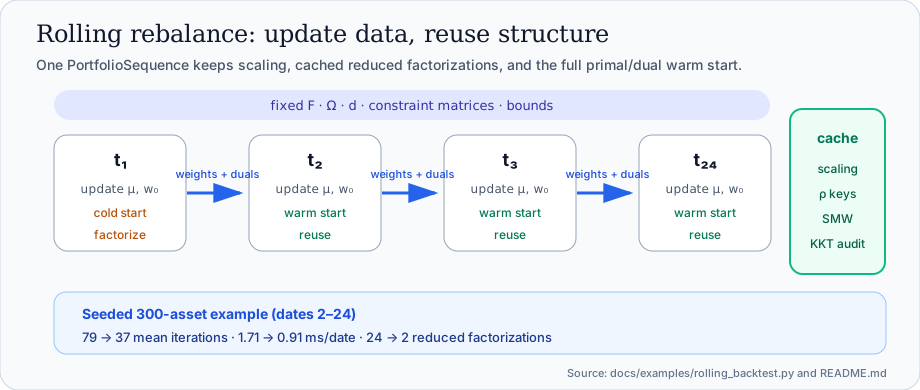
Rolling workloads — daily or weekly rebalances where mostly the expected
returns and the previous holdings change — are the workload Ledge is built
around. A PortfolioSequence keeps the Ruiz equilibration and the reduced
factorizations cached across dates and chains full primal/dual warm starts
automatically.
Python
sequence = problem.sequence()          # solver kwargs accepted here
for date in dates:
    result = sequence.solve_next(
        expected_returns=mu[date],
        previous_weights=held,         # turnover anchor for L2 and L1
    )
    held = result.weights
solve_next accepts only factorization-preserving updates:
| Keyword | Rolls |
|---|---|
expected_returns | the linear cost |
previous_weights | the L2/L1 turnover anchor |
benchmark_weights | the tracking benchmark (base problem must have one) |
budget | the budget row RHS |
equality_rhs, inequality_rhs | constraint right-hand sides (including template targets) |
Structural changes — covariance, constraint matrices, bounds, turnover penalty — are rejected with an explanatory error: build a new problem and a new sequence. This makes the cost model visible in the API: everything a step can express reuses the cached factorization.
Steps are atomic. A rejected date (bad feed, impossible budget) leaves the
sequence exactly as it was, so production loops can skip it and keep
rolling. An unconverged date (MaxIterations) does not abort the sequence;
an infeasible date restarts the next date cold so diverged duals never
poison the warm start.
Rust
let mut sequence = problem.sequence()?; // or sequence_with(&solver)
for step in steps {
    let solution = sequence.solve_next(&step)?; // step: RebalanceStep
}
// One-call form over a precomputed step list:
let solutions = ledge::solve_sequence(&problem, &settings, &steps)?;
Measured effect
From the repository's seeded momentum backtest (300 assets, 12 factors, 24
monthly dates, 10 bps L1 costs, tracking benchmark; see
docs/examples/README.md in the repository): warm dates converge in 37
iterations vs 79 cold (2.1x), 0.91 ms vs 1.71 ms (1.9x), and factorizations
drop from 24 to 2 across the backtest. Rolling steps reach a steady state of
zero refactorizations because revisited penalties hit the workspace
cache.